There’s a pattern that shows up consistently with hardware founders. They’re brilliant. They’ve solved harder problems than most people will ever face. And because of that, they tend to trust their instincts over any formal process.
That’s not a flaw. It’s often exactly what gets a hardware company off the ground.
But that same instinct can make strategy work feel like a waste of time. You already know your product. You already think you know your customer. Why stop to fill out a framework?
Because the questions you haven’t answered are the ones that will hurt you.
The Questions Most Founders Skip
Hardware startups rarely fail because the product is bad. They fail because the founder never stopped to ask the right questions early enough.
Who exactly will pay for your solution — and at what price? Do the unit economics hold at any realistic production volume? Who makes it, where, and what happens when that relationship breaks? What certifications do you need before you can legally sell a single unit?
These aren’t soft questions. They’re the ones that determine whether a company survives its first year.
The problem is that most strategy frameworks were designed for software companies. They have no concept of a bill of materials, a contract manufacturer, or a compliance certification. Hand one to a hardware founder and the most important sections are left blank — not because the founder is careless, but because the tool wasn’t built for the job.
A Framework Built for Physical Products
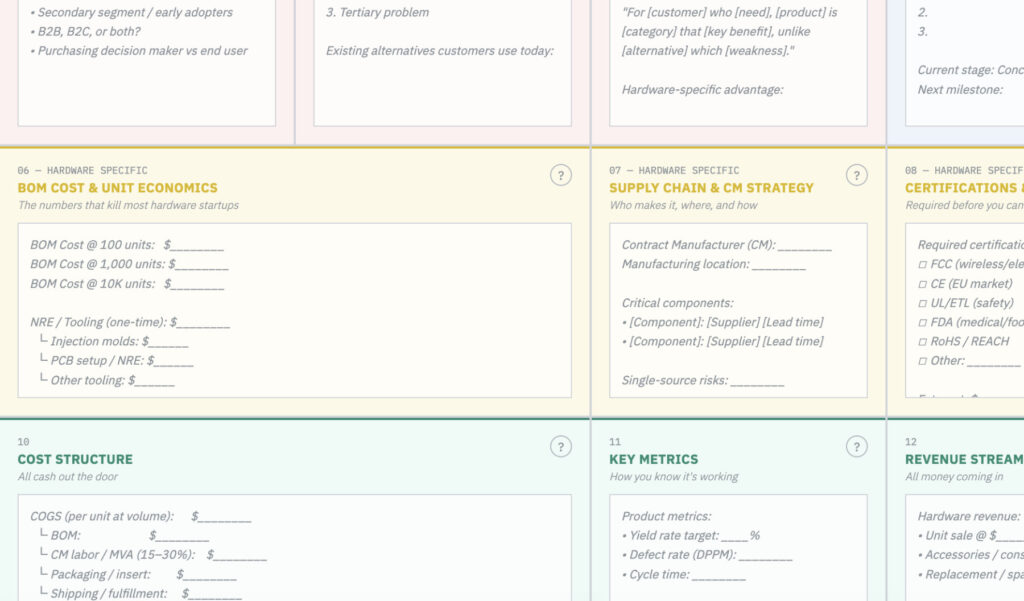
The Hardware Startup Canvas addresses this directly. It’s a 12-section strategic planning tool built specifically for physical product companies, based on Lean Canvas with hardware-specific extensions — including the three areas most frameworks skip entirely: BOM cost and unit economics, supply chain and CM strategy, and certifications and compliance.
The goal isn’t to slow founders down. It’s to apply the same rigorous, iterative thinking that makes great engineers exceptional — to the business itself.
The Exercise
We run a live, 2-hour working session for small groups of hardware founders to work through the canvas together, in real time. It’s not a lecture. By the end, participants leave with a completed canvas, their biggest strategic risks named and prioritized, and a 30/60/90-day action plan to start closing the gaps.
The earlier a founder does this exercise, the more value it returns. The canvas works at any stage — idea, prototype, early revenue. And unlike most strategy tools, it gets more useful the more specific you are.
If you’re building a physical product, this is the exercise worth doing before the market forces you to.